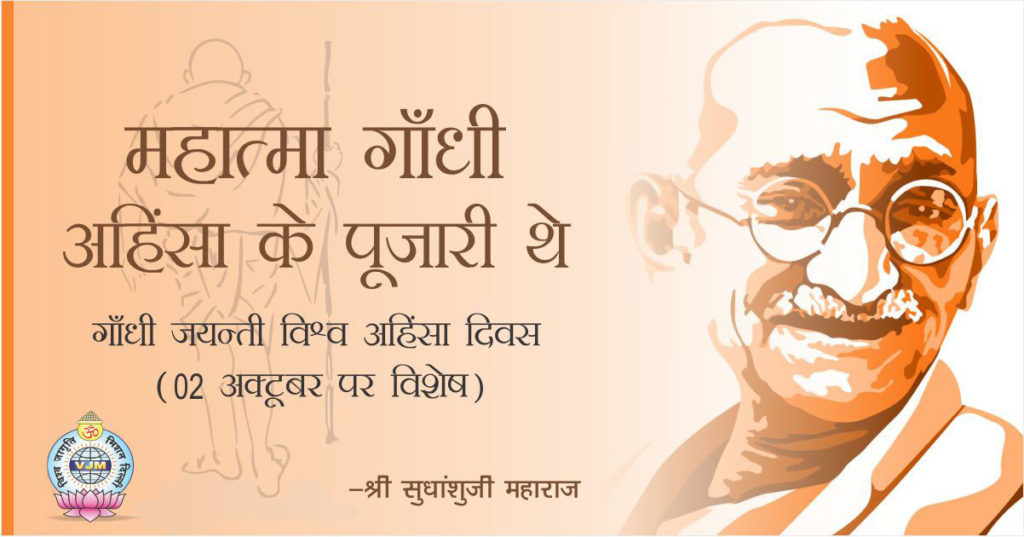
Mahatma Gandhi was a preacher of non-violence
(Special on Gandhi Jayanti World Non-Violence Day 02 October)
Mahatma Gandhi, the worshipper of non-violence, was born on 2 October 1869 in Porbandar, Gujarat. To pay tribute to him, his birthday is celebrated on 2 October. 2 October is included in the national festivals of India and on this day there is a government holiday in all the states of India.
Celebrating 02 October as World Non-Violence Day:
The United Nations General Assembly decided on 15 June 2007 that 2 October should be celebrated as World Non-Violence Day. This day is celebrated in the memory of Mahatma Gandhi, who fought all his life against the British for the independence of India. He resorted to non-violence for independence, he wanted to live with peace and truth. Mahatma Gandhi, also known as Bapu, gave everyone a basic mantra of simple living high thinking. He was a strong opponent of intoxication, therefore the sale of liquor is banned on 2 October. He also went to jail many times for freedom, he continued the non-violence movement till independence. He was a strong opponent of untouchability, he considered all human beings equal.
On 2 October, most politicians and government officials offer flowers at the Samadhi of Mahatma Gandhi located in Delhi and religious prayers of all religions are also offered at the Samadhi in the morning. It is celebrated as a national festival with great pomp in all government offices, schools and colleges. Gandhi ji was a barrister, but he dedicated his life for the country from which today's modern society takes a great inspiration.
Mahatma Gandhi ji did great work to achieve Swaraj, eradicate the great evil of untouchability prevalent in the society, improve the economic condition of the farmers of the country, improve the pitiable condition of women and empower them. With the help of people, he started the Non-Cooperation Movement in 1920, Dandi March or Salt Satyagraha in 1930 and Quit India Movement in 1942 on a large scale, as a result of which the British had to leave India.
Mahatma Gandhi ji resorted to the Civil Disobedience Movement and carried out a non-violent movement to get the demands of the British government accepted by the protesters in a peaceful manner. Many civil disobedience movements were carried out against many harsh acts and laws of the British government. The Civil Disobedience Movement was started in 1919 along with the Non-Cooperation Movement in protest against the Jallianwala Bagh incident in which the British rulers killed hundreds of unarmed people.
The British rulers had imposed a heavy tax on salt. Against which Gandhi started the Dandi March for the Salt Satyagraha, as this journey progressed, people started joining it and the British tax system started being opposed. A large number of arrests were made on this occasion, but the British government was unable to stop this movement. This journey continued for 26 days in which the Indians achieved success and started making salt in large quantities at the local level. Due to this movement, people started opposing British goods and the use of indigenous products started being given more importance. People started burning British clothes and farmers also refused to pay taxes to the British government, due to which the British administration felt very bad. Along with this, Indians working in the British administration started resigning and women also started participating in this movement in large numbers, due to which the foundation of British rule started shaking.
This movement gave a big blow to the British government at the economic and administrative level. Due to the Swadeshi movement, many manufacturing units were opened in India for the production of products. This had a great impact on the products imported from Britain, due to which the import of cigarettes decreased. Salt production started in the country. Due to the Disobedience Movement, the British government also started thinking about how to deal with this non-violent and disobedience movement because it was a movement in which there was no justification for the use of force.
It was because of Mahatma Gandhi that the Indian freedom struggle got an international platform and the whole world acknowledged his strong determination and willpower. He showed the world the power of non-violence and made people understand that not every battle can be won with violence, but some battles can be won by following the path of non-violence without shedding a single drop of blood.
Other leaders of the world also created history by following the path of non-violence and truth shown by Mahatma Gandhi. They fought against injustice, oppression, poverty, discrimination through peaceful struggle in their respective fields of work and won. Mahatma Gandhi was such a personality whose thoughts taught the whole world the lesson of peace, harmony and non-violence. There have been many great people in the world who were deeply influenced by Gandhiji's thoughts. Prominent among them are Martin Luther King, Dalai Lama, Aung San Suu Kyi, Nelson Mandela, James Lawson and Mother Teresa. All of them chose the difficult path of peace and non-violence and created history. These great people who gave the message of peace to the world were also awarded the Nobel Peace Prize.
Conclusion:
In the end we can say that any movement done peacefully is successful. It neither causes trouble to the people of the society nor does it cause any damage to government property. We should consider movements as a form of protest.
While doing this, we should keep in mind that no one should face any trouble due to our movement.